
What We Leave in the Grass
On stewardship, the cost of performance, and what gets passed on

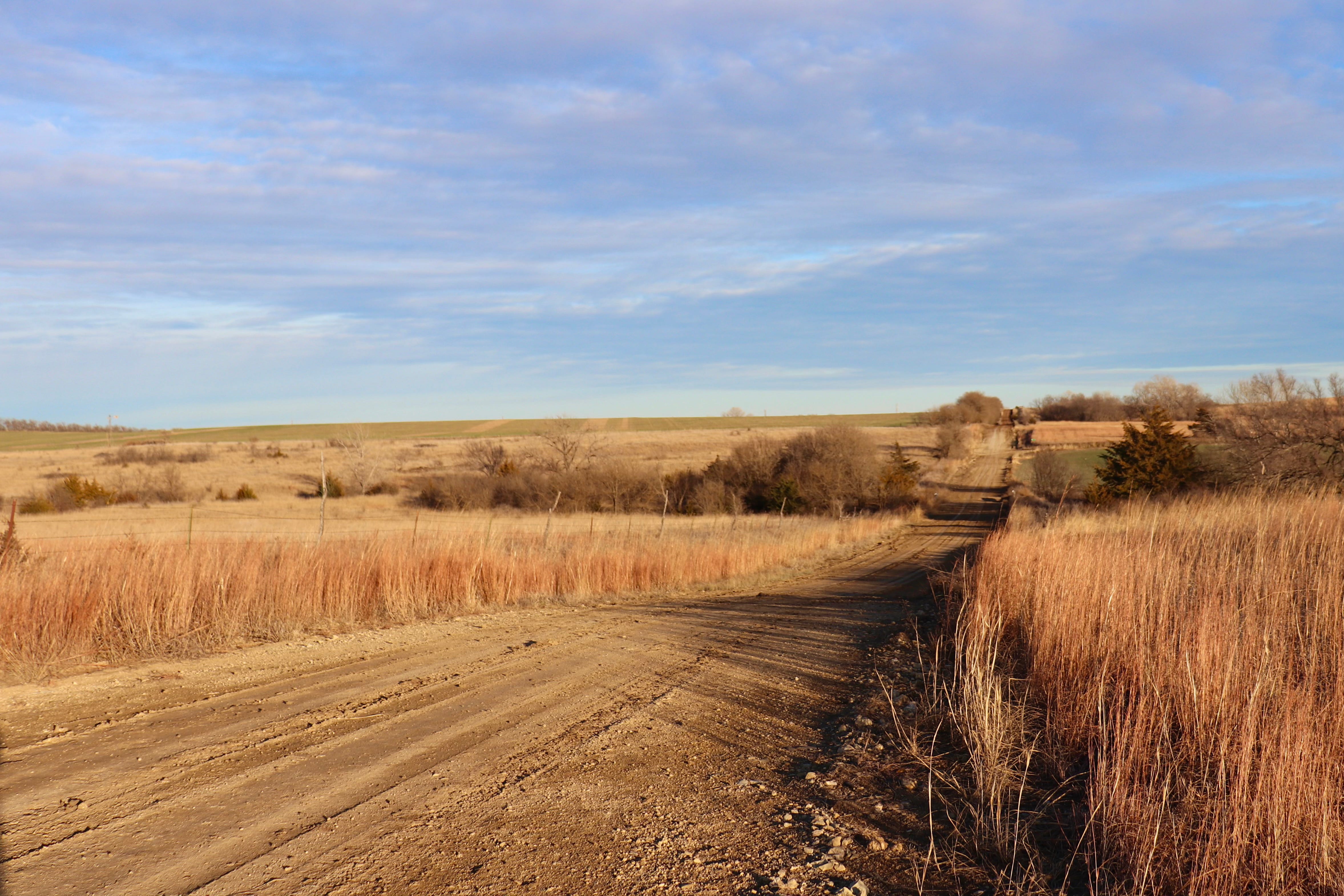
Photo Caption: A road runs through inherited country, carrying the marks of those who came before, leading toward something that has not yet been reached.
There is a word I have spent a long time avoiding in my writing.
Not because I do not believe in it. Because I do. The word is stewardship, and I have watched it get pinned to so many mission statements and corporate values that I have grown protective of it. The more places a word lives, the less it tends to mean in any of them. So I have left it on the shelf, used it sparingly, and tried to write around it whenever I could.
Today I am going to take it down and use it on purpose, because I believe this piece will not work without it.
By definition, stewardship is the responsible care of something entrusted to you. The active, ethical oversight of a resource, relationship, or tradition, with long-term sustainability in mind rather than short-term gain. It applies to land. To money. To organizations. To people. It applies, most of all, to the things we did not create and will not own forever, but have been given the chance to carry well for a stretch of time.
The Bible names stewardship directly thirteen times. The concept itself runs through more than two thousand verses. The instruction at the start of Genesis (1:28) is plain. “Take charge.” Care for what has been placed in your hands. Be faithful with what you have been given. Use your gifts to serve. Manage what you have been entrusted with so that it is still here, still healthy, and still worth something when the next set of hands receives it.
Stewardship is not a small word.
It is also the word, I am realizing as I write this, that is the undercurrent to nearly everything I have published with Chasing the Quiet Pull.
I write about bird dogs and upland hunting because they have become the clearest language I know for talking about how a person learns to live. The dogs and the country are not the whole story. They are the cathedral inside which the real story takes place. The miles, the silence, the wind, the long unbroken hours of nothing happening at all. Those are not the settings waiting for the action to begin. Those are the action. They are the work, and the place the lessons get taught.
What the prairie has given me, slowly, across more years than I would have predicted, is an awareness of the difference between performance and presence.
Some days the birds come early and often. The dogs lock up with the same fire they showed at the truck. The shots are clean, and the bag fills before lunch. Those days are fine. However, they are not the days I think about most.
The days I carry are the long ones.
The long walks through heavy grass with nothing rising while the wind moves through the grass in a slow steady rhythm that sounds, if you stand still long enough, very much like prayer. The days when light stretches low across the country until the whole world feels like it is holding its breath. In those hours there is nothing to post and nothing to prove. There is only the work itself. The companionship of a dog doing exactly what he was made to do. The steady rhythm of boots on earth. The slow understanding that you are standing inside something far larger than yourself, and you have been allowed, for a few hours, to participate in it.
That understanding is what the uplands teach anyone willing to slow down and receive it.
It teaches patience, when you have walked for hours and seen nothing, and the dog is still working with the same belief something is about to happen.
It teaches presence, because the country and the dogs together demand it, and the moment you check out, you miss the very thing you came for.
It teaches gratitude, the kind that arrives unbidden when the light goes long across the horizon and you realize you are witnessing God’s artistry firsthand.
These three things, in that order, are what I believe the work is for. They are also what I believe stewardship requires.
You cannot care for something you have not first learned to be patient with. You cannot protect something you have not first learned to be present to. And, you cannot carry something forward with the right hands unless gratitude is what is moving them.
The dogs have known this all along. They work with everything they have whether anyone is watching or not. They hold their points with the same intensity on an empty hill as they do when the birds are thick. They do not perform for applause. They do what they were made to do, and they do it with complete faithfulness.
It is the way the dog still believes after the empty miles.
I believe, myself included, we are all still trying to learn what they have always known.
There is something I want to be careful in naming here, because I do not want to be heard wrong.
I am not writing this piece to complain about how the world has changed. The world is going to change. The world has always changed. Every generation receives a thing in one form and hands it over to the next generation in a slightly different one, and that is the cost of being alive at any moment in history.
What I am writing about is something quieter than complaint, and older than nostalgia.
I am writing about the responsibility a person carries when they have been entrusted with something they did not invent and cannot take with them. The land. The dogs. The traditions. The understanding of how to be still long enough to hear what the country is saying. None of that started with me. None of it will end with me. I am only one set of hands in a long line of hands, and the question I keep coming back to is whether the thing I pass on will still resemble the thing I was given.
That is the question stewardship asks. It does not ask whether you enjoyed yourself. It does not ask whether you were successful. It asks whether the thing in your care is still healthy when you are done with your turn.
A culture that rewards performance over everything else does not ask that question very often. It asks faster questions. Did it perform well? Did it convert? Did it scale? Did it land? Those are real questions and they have their place. But they are not stewardship questions. Stewardship questions take longer to answer because they are measured in generations rather than quarters, in inheritance rather than engagement, in what survives rather than what trends.
I worry, sometimes, that we have stopped asking the long questions because the short questions are louder.
I have watched what happens when those lessons are forgotten.
I watched it happen in the world of waterfowl hunting more than a decade ago. A television show caught fire in the early 2010s and pulled waterfowl hunting into the mainstream almost overnight. I am not exaggerating when I say the change was visible inside a single season. Quiet stretches of water once still for decades, suddenly were packed with new members to the sport.
I remember a morning in Kansas specifically. We had set up well before dawn on the shore of a lake we had hunted for years. The sky was just beginning to gray when a group of trucks pulled into the parking lot a hundred yards off. Two men, somewhere in their early twenties, climbed out and began opening boxes. New decoys. New waders. New shotgun. We watched them carry their gear down to the water and start tossing decoys into the lake without weights, then sit on a rock in the open and wait.
When the birds came, they shot at everything. Distance did not seem to factor in. Neither did direction. We were peppered hard enough that I set my gun down and walked over to talk to them.
What I found, when I got there, were two kids sitting in the open with trash already strewn around them, watching the unweighted decoys drift slowly out of casting reach, never to be recovered. I asked them what they were doing. They told me, openly and without embarrassment, that this was their first hunt. They had learned how to hunt from the show.
I have thought about that morning for more than a decade.
It would be easy to make those two young men the villains of the story. They are not. They were doing exactly what they had been taught to do by the only teacher available to them.
The villain, if there is one, is the long quiet failure of a culture that decided spectacle was good enough to pass off as instruction. A culture that decided the show was the story, and concluded the kill was the proof. The decision had been made that the ethics, the patience, the responsibility, and the slow apprenticeship of learning to do the thing well were optional details that did not need to be passed down with the gear.
What followed in that community over the next several years was a slow shift I watched happen in real time. The conversation moved away from the work and toward the result. The wetlands stopped being a place and became a backdrop. The hunt stopped being a relationship and became a content category. Decoy spreads got more elaborate. Camo got louder. Boats got faster. Videos got slicker. The sacredness of the thing, which had once been the whole reason to be there, was quietly stripped out and replaced with performance.
Waterfowl hunting was something I genuinely loved. It is no longer a place I spend my time. The culture moved somewhere I could not follow, and the overall experience was no longer worth the time, effort, or money.
I do not write this to be cruel about anyone, including those two young men in Kansas, who were almost certainly doing their honest best with what they had been given. I write it because the same current is moving, more slowly, through other hunting traditions right now. Big game has felt some of it. Upland is starting to.
I have watched what commercialization does to a tradition when no one steps in to slow it down. The shot becomes the story. The body count becomes the proof. The slow apprenticeship and the sacredness of the thing get stripped away, and what is left is performance.
I want no part of that, and I want you to know it.
There is something I want to say about engagement before I move on, because I do not want anyone to mistake what this piece is doing.
I am not a purist, nor am I an elitist. I have shared photos of birds on tailgates and on fence posts. I will share more. The point is not the photo. The point is what the photo is for, and what the photo is allowed to mean, and what gets crowded out of the frame when the photo becomes the entire story.
Limits get more attention than reflection. A young person picking up the sport today will see, almost without fail, that the kill is the part that gets rewarded. The patience is invisible. The presence is invisible. The gratitude is invisible. The covenant is invisible. The slow apprenticeship is invisible.
If invisibility is the long-term forecast for the things that actually matter, then the things that actually matter will not survive another generation in a form worth inheriting.
This is the deeper concern.
Not whether anyone gets to take a bird home. Not whether anyone gets to share a photo. Not whether the sport survives in some technical sense, because it will, with bigger marketing budgets and more elaborate gear than any of us asked for.
What is at stake is whether the soul of the thing survives.
Whether the slow walk survives. Whether the empty miles survive. Whether the four-mile silence with a dog still believing in front of you survives. Whether the prayer-rhythm of wind through grass survives the relentless pressure of a culture that monetizes what it cannot first sit still long enough to love.
That is what we are stewards of, whether we realize it or not.
I believe this is why the writing has felt different than other things I have tried.
There is a particular kind of quiet that comes over a person when they realize they have been entrusted with something. Not chosen for it. Not specially qualified for it. Simply present at a moment when something needed carrying, and willing to pick it up. That quiet has been with me every time I have sat down to write one of these pieces. It is not pride. It is closer to the feeling of being handed an heirloom and being told to take care of it for a while.
The heirloom in this case is not mine. It belongs to everyone who has ever walked behind a good dog and understood, somewhere wordless, what was being given. It belongs to the men and women who shaped these breeds across centuries with patience I cannot fathom. It belongs to the country itself, the prairie and the brush and the timber, which has been here longer than any of us and will be here long after we are gone if we treat it well. It belongs to the next generation of hunters, who will inherit whatever we leave them, in whatever condition we leave it in.
My job is to carry it well for the stretch of time I have it.
That is the stewardship I am trying to practice. Of the land. Of the dogs. Of the tradition itself. Of the stories. Of the culture we pass on.
So here is what I am trying to do with this publication, and I want to be plain about it, because I do not think I have ever said this directly before.
I am trying to be faithful to the long form of this thing. The slow form. The form that values a dog who still believes after sore paws and empty miles. The form that values a sky doing what skies do at last light, and a tailgate at the end of a hard day, and the press of a head against your knee, and the silence between two friends who do not need to fill it. The form that understands the kill is at most five percent of the story, and that the other ninety-five is what actually changes a person who is willing to be changed.
I am trying to write about that other ninety-five percent.
Not because the kill does not matter. It matters in its own way and in its proper place. But because almost no one is writing about the rest of it, and the rest of it is what will be lost if no one writes about it at all.
If a young hunter somewhere reads one of these pieces and decides to value the walk more than the shot, that matters. If someone who has felt out of step with where the culture has been heading reads one of these pieces and feels less alone, that matters. If a single person comes away from this work understanding that bird dogs are not accessories and the prairie is not a backdrop and the tradition is not a content category, that matters.
That is what I hope to leave in the grass.
Not just footprints. Not just spent shells. Not just the memory of birds taken or birds missed. But the quiet understanding that some things are worth protecting, worth doing well, and worth passing on with care, even when no one is watching, even when the immediate reward is small, even when the culture around us seems to reward everything except the long and faithful work.
The dogs have known this all along. They have never needed an audience, nor have they ever needed a reason. They have simply done the work they were made to do, with complete faithfulness, in front of whoever happened to be there.
I am still learning to follow.
Traditions do not preserve themselves. They are kept alive by people who choose, day after day, to value the long view over the immediate result. Who choose to measure success by something deeper than engagement metrics or filled limits. Who understand what we leave in the grass matters as much as what we take home.
If the work I am trying to do here finds its way to someone who needed to hear that there is still room in this world for patience and presence and careful stewardship, then the miles were worth it. Every one of them.
The dogs have shown me the way.
I am simply trying to follow.
Until the next cast…
Stay steady, trust the dog, and chase the quiet pull.
God bless,
Abram