
What the Dogs Know About Time
A meditation on presence, loyalty, and the way good dogs measure life

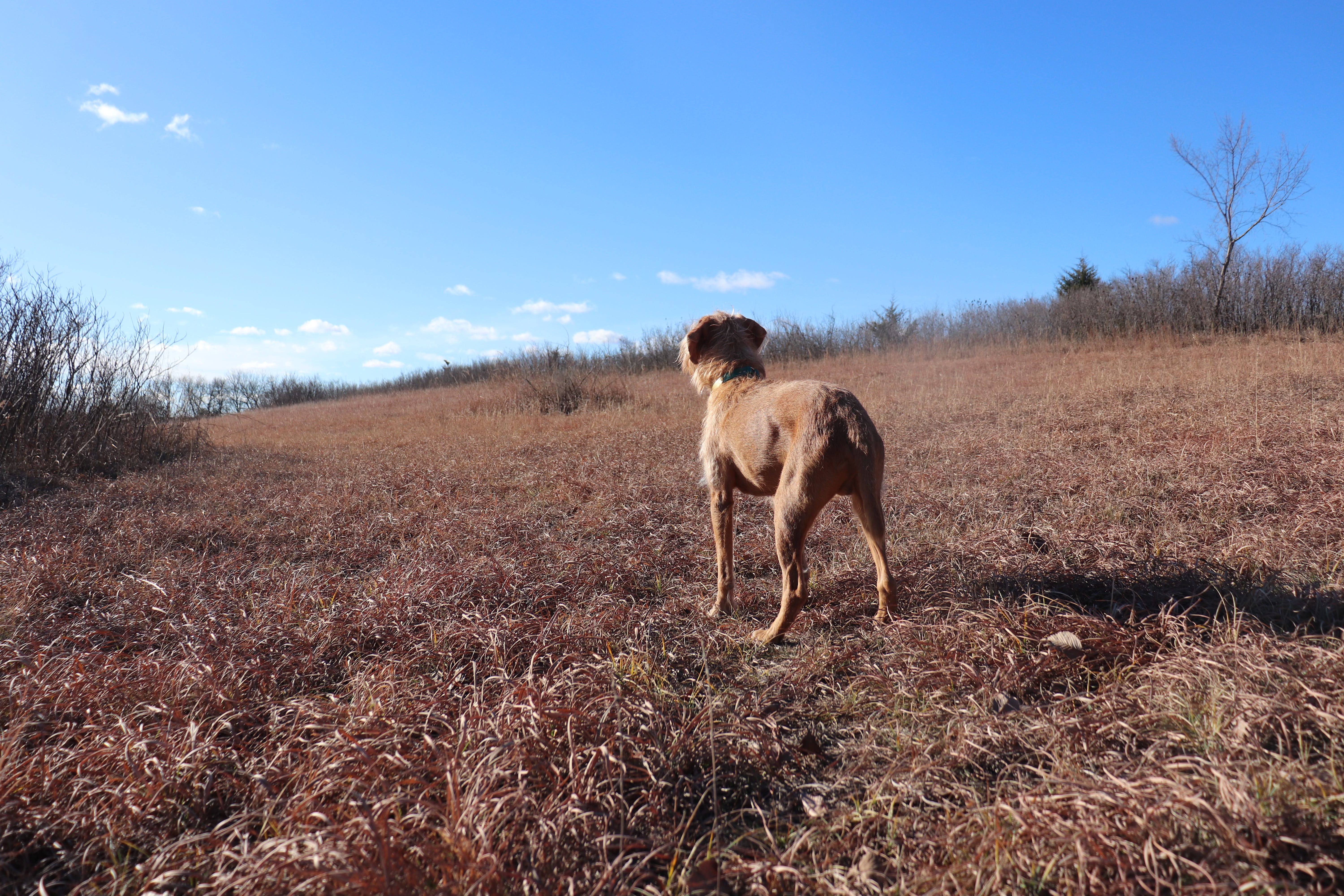
He used to run. Now he watches.
My hand reaches for the ornate door knob that leads onto our deck, and the cold of the rubbed bronze surface gives me a sharp preview of what waits outside. An unseasonable late-April air mass has drifted down from Canada and settled into the Sandhills of North Carolina, dropping the morning into the mid-thirties. Frigid to neighbors who have called this state home for years. Mildly cold to anyone raised in northern climates. Absolutely perfect for me. I have lived in this state for nearly ten years and I am still a midwesterner at heart and climate preference.
The moment I begin to open the full-length glass door, a three-dog traffic jam forms at my feet. Dunham, Henry, and Theo are anxious for their morning ritual of inspecting the landscaping for whatever may have visited overnight. The sun, still in its early stages of waking the world, illuminates their exit with dappled light. I step out, fill my lungs with the cold air, and turn to give the command granting the gridlock behind me permission to commence its survey.
Theo is first across the threshold, every ounce of puppy energy compressed into a wirehaired vizsla frame that has not yet figured out the dimensions of its own enthusiasm. Henry, seven-years-old now, follows with the agility his Llewellin setter blood granted him. He fakes right towards the eagerly awaiting Theo, then jukes left around the patio chair as if some kid is working him with an Xbox controller, and the two of them are gone before I can take the first sip of my coffee. Up and over two retaining walls. Disappearing into the timber. Already chasing whatever is over the next hill.
Dunham comes last.
He no longer steers his body with the reckless abandon that defined him for a decade. Now, our oldest wirehaired vizsla and his nearly thirteen-year-old body navigates with leisure rather than haste. With deliberateness rather than spontaneity. His joints are beginning their unkind decline, forcing him into a different pace.
I close the door behind him as he passes, and I move with my coffee to my swivel rocker overlooking the back of the property.
The ceramic mug goes onto the side table. Ribbons of steam climb into the cold morning air. The forest does what the forest does at first light. Chickadees, cardinals, and nuthatches build a steady chorus, amplified whenever the pileated woodpecker drops in with his rapid drum solo. The dappled sunlight comes through the white oaks and longleaf pines, laying itself out across the deck in soft, moving shapes.
This is one of my favorite places to gather my thoughts before the noise of the world creeps in to steal whatever attention I will give it. So I sit. I sip. I let God’s morning speak its melody.
And I watch Dunham.
He has not followed Henry and Theo. He never does anymore. Instead, he is walking along the first level of the retaining wall, conducting a slow methodical inventory of the shrubbery the younger two ran past without a glance. He stops at every azalea. Every clump of tickseed. Every catmint. Every spirea on the route to the old holly stump where he routinely relieves himself. He is not in a hurry. He is not heading anywhere in particular. He is just here, smelling each thing as if he is meeting it for the first time.
He never used to do this.
For ten years, Dunham was Henry and Theo. He was the one who sprinted across the yard before I could close the door. He was the one who appeared at my feet with a tennis ball at every moment I sat down, with an insatiable appetite to play fetch all day, every day, until my arm gave out long before his interest did. The dog who once carved 400-yard arcs across vast prairie now strolls. The dog who would barrel past a dozen azaleas to chase whatever moved in the trees now stops to smell each one.
Something has changed in him, and the change is not just slowness.
He has grown more present.
The thought lands as I sit with my coffee, watching him work the shrubs with the kind of attention that has nothing to do with hunting and everything to do with being. The other two are off doing what they were doing minutes ago. Dunham is here. Fully here. In a way the younger two have not yet learned to be.
When he finishes his inspection, he climbs the deck steps with the careful negotiation that has replaced his old leap. He approaches my chair, performs the three slow circles that have become his ritual, pauses to gather himself, swings his hindquarters with deliberate care, and settles his entire body across my feet. An audible sigh confirms he has arrived where he intended to. His head stays high. His clouded eyes look out into the timber where the younger two have disappeared. And he stays.
He will not move now, until I do.
This, too, is new. A year ago he would have settled briefly and then gotten up to follow Theo to the far edge of the property. Two years ago he would not have settled at all. He would have been at the railing watching the younger two, waiting for me to throw something, anything, that he could chase. Now he is content to be where I am. Whatever I am doing. However long I am doing it.
A bird dog person spends a long time learning to read their dogs. What I am reading in Dunham now, in this season, is something I do not yet have the right vocabulary for. It is not resignation. It is not surrender. It is not what people usually mean when they say a dog is winding down. It is the opposite of all of that. He is more attentive than he has ever been. He notices things he used to blow past. The morning light on the deck. The quality of the air. The particular weight of his own body settling against mine. He is here in a way he never was when he was younger, when the next thing was always pulling him toward it.
The dogs have always known something about time that we have trouble comprehending. They are not the only creatures who know it. The country knows it, in the slow way the prairie absorbs a season. The light at last hour knows it, in the way it lays itself across the grass without hurry. We are the ones who have forgotten, somewhere along the way, the older instruction about how to be where we are. The dogs have not forgotten. They are still showing us, daily, what we were once meant to know.
We tend to think of time as a line. Yesterday behind us, tomorrow ahead, today as the small narrow place where we are momentarily standing. We spend most of our energy reaching forward. Planning the next trip. Anticipating the next meeting. Worrying about the next thing that may or may not happen. The present moment is, for most of us, a corridor we hurry through on the way to something else.
Dogs do not experience time this way. They live in what people who study these things call the eternal now. The smell on the breeze right now. The person walking through the door right now. The exact quality of light on the floor right now. They are not waiting for the next moment to be better than this one. They are not regretting what already happened. They are inside the present in a way most of us cannot remember how to be.
But here is the part most people miss when they describe a dog’s relationship to time. The dog is not living in the now because he has forgotten everything else. The dog is living in the now because everything else is also there, in the form of recognition.
Dunham’s eyes are clouded. His hearing is selective on the best days and nearly absent on the rest. But the moment I touch the field collar bag, the bag I only handle when we are about to hunt or about to travel to hunt, he transforms. He is at my feet before I have finished lifting the strap. He bounces around like a puppy. He is not remembering hunting. He is currently encountering hunting, because the trigger has appeared and the trigger is, for him, indistinguishable from the thing it points to.
In February, when I finally had time to put hunting gear away after our December trip to Kansas, I started moving clothes into totes in our former gym that I transformed into a new gear room in the detached garage. Dunham was beside me through every step, sniffing each piece of clothing as though he was about to walk into wheat stubble that morning. The gear was the country, in his perception. The smell of it, the look of it, the touch of it, brought back not a memory but a present-tense return to everything those things have ever meant.
Even our neighbors’ pool, which he has not been in for seven years, is still alive in him on hot afternoons. He still walks the path to their yard. He still stops at the gate, looking at the water, like a child asking for permission to swim. The pool is not a memory to him. The pool is here, in the smell of the air on a hot day, along a route his paws still know.
When my mother visits from Tennessee, he does not greet her the way a dog greets someone he has not seen in a year. He greets her the way a dog greets someone he has been waiting for. Grandma is not a memory either. Grandma is, in his perception, the person who is currently arriving, even though it has been months.
Loyalty, in a dog, is memory made visible. The years are not behind him. The years are inside him, accessible, present, ready to surface the moment a trigger calls them forward. The bag. The clothes. The path to the pool. The sound of grandma’s car door. He has forgotten nothing. He simply does not access those things the way we do, through deliberate recollection. He accesses them through being where he is, fully, while the residue of every meaningful thing that has ever happened to him is also present in the moment, as the moment.
This is what the dogs know about time that we’re still trying to learn.
Time, for them, is not a line. It is a layered present, in which every previous moment that mattered is still alive, and every future moment is irrelevant until it arrives. They are not anxious about tomorrow because tomorrow is not real. They are not grieving the past because the past is not gone. The past is here, in the smell on the breeze, in the bag in my hand, in the voice of someone they love.
There is a teaching in this that aligns with something older than dogs and older than the prairie they have taken me into.
I was told, in the quietest possible way, that the instruction was always to stop reaching for the next thing. To receive each day as the day that is, with the residue of every grace already given, without grasping at what has not yet arrived. The dogs have been showing me this for as long as I have walked behind them. I was just not ready to see it until recently. The Lord has been patient with me. The dogs have been more patient still.
I know more about borrowed time than I used to. The collapse nearly three years ago made that real for me in a way it had not been real before. There were weeks when tomorrow stopped being something I assumed and started being something I hoped for. The hand in the ambulance told me I had a life to live. What it did not tell me, at least not in words, was how. The how has been arriving slowly, in small pieces, often through the company of a dog who has been quietly demonstrating it the entire time. The testimony came in a single moment. The teaching has come in mornings like this one in the cool late-April air.
Be where you are. Receive what is given. Remember everything that mattered, and do not covet the next thing.
Sitting on the deck with Dunham asleep on my feet, the coffee cooling in my mug, the pileated woodpecker doing his solo somewhere in the longleaf pines, I am beginning to understand the lesson God is teaching me now is the same lesson He was teaching me three years ago. The language is just different. The hand was the testimony. The dog is the daily practice. He has used both to say the same thing, in the only ways I was ready to hear it.
Henry and Theo came crashing back somewhere around the twenty-minute mark. Exploding out of the timber, panting hard, tongues out, eyes bright with whatever they chased that I will never know about. Theo skids to a stop at the bottom of the deck stairs, looking up at me with the unmistakable expression of a young dog who is already eyeing the next thing. Henry is right behind him, his white feathering streaked with the morning dew of the woods.
Dunham lifts his head. He sees them. He acknowledges them with the slight ear flick of an older brother who has watched this exact scene a thousand times. Then he lays his head back down across my feet.
He does not get up.
The younger two will catch up to the lesson eventually. I did. He did. Every dog and every person who has ever lived long enough to slow down has eventually arrived at this same morning, in some form. The vantage point. The cold air. The companion at their feet. The woods doing what woods do at first light. The long, slow, unhurried gift of a day no one was promised and was given anyway.
This is what the dogs know about time.
Receive the morning. Carry the years. Do not chase what has not yet arrived.
Be where you are.
Until the next cast….
Stay steady, trust the dog, and chase the quiet pull.
God bless,
Abram