The Bonds We Forge
A hunter’s reflection on love, loyalty, and the quiet art of the bird dog

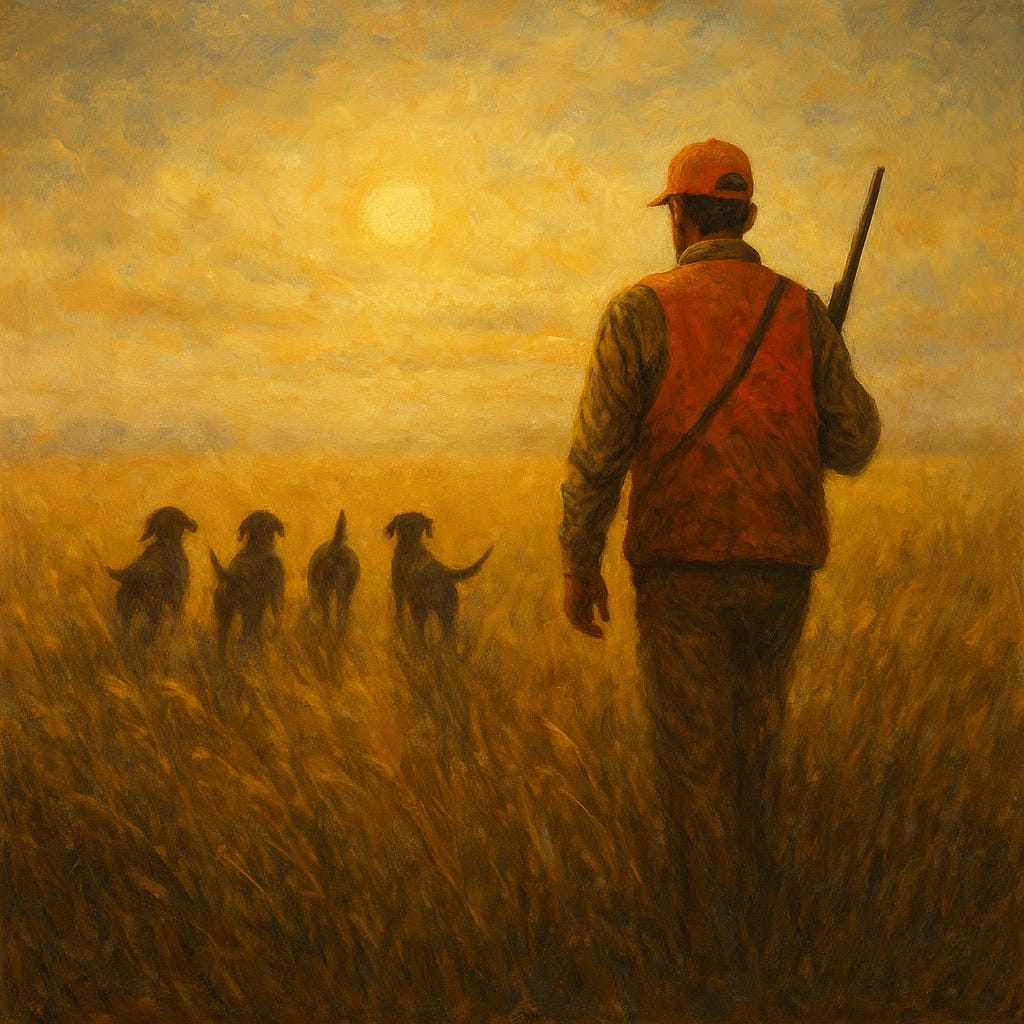
Author’s note: This is the final piece I’m bringing over from Medium, and it may be the most important one yet. It’s a love letter to Gus, Dunham, Henry, and Theo — the four dogs who turned miles into meaning and taught me what real partnership looks like. If you’ve ever felt that invisible thread between hunter and dog, I hope this resonates with you.
A meditation on the bond between hunter and bird dog, told through the lives of four companions who turned miles into meaning.
This isn’t an argument about methods or camps.
It’s a love letter to the dogs who hunt with us, the miles we share with them, and the quiet language that binds us.
What follows isn’t a claim that bird-dog bonds outrank anyone else’s. I’ve loved dogs who never saw a covey rise, and I respect every honest bond between a person and a dog. Still, there’s a particular alchemy when a dog’s instinct meets a human’s care, when scent and wind, grass and wing fold into a living duet.
If you’ve been there, you know.
If you haven’t, allow me to try, through the four dogs I’ve had the privilege of loving and following, to show you what I mean.
When the World First Went Still
My first bird dog was Gus, a Vizsla who came into my home in 2008. He was a runner’s companion and a prankster, a counter-surfing thief of bread with a baritone groan that filled a room. We were bonded before we ever hunted; miles of pavement and the small rituals of a young dog made us a unit.
Then, one day, for fun, we were invited into a field with pen-raised birds and field-trial champions watching. I wore a University of Tennessee t-shirt as if my first alma mater’s orange cotton could substitute for the blaze I hadn’t yet earned. Gus, with no bird experience or polish, abruptly stopped. The air changed. Goosebumps climbed my arms. He locked into a point with a stillness that looked and felt like prayer.
That single moment widened my life. I fell in love with everything upland, with the Northern Plains, with the constant shiver of waist-high grass as the wind combed it toward a horizon that never seemed to end. I learned a dog can open a door you didn’t know existed, and on the other side lies a country you’ll spend the rest of your days trying to understand.
“A man who has never spent hours afield with a companion hunting dog as partner has missed one of life’s great experiences,” a fellow upland hunter once said over bourbon while sitting at bird camp.
He wasn’t bragging. He was naming a simple truth: a good dog will hand you back a part of yourself you didn’t know you’d misplaced.
The Force Beside Me
If Gus was finesse, Dunham, a Wirehaired Vizsla, was thunder.
We began in Kansas in 2013 and wrung four full seasons for all they were worth, our days set by migration’s ebbs and flows. If the waterfowl were plentiful, Dunham was in the morning water and in the field by lunch. If the flight was slow, we chased upland birds from sunup to sundown. We hardly missed a day: ducks on ice-rimmed water, quail erupting from millet rows, all while embracing the late-afternoon prairie quiet that feels like church.
Dunham hunted with muscle and grace, and he hunted for me. He knew my mood, my pace, the precise length of my whistle when I meant come now. We were so attuned that sometimes a simple look was enough for a complete sentence. I’ve come to believe there’s a second engine in a bird dog. Beneath instinct, there’s devotion. When he hurled himself into thorns, he wasn’t only chasing scent. He was running down the chance to place joy in my hands, a shared purpose living where our footsteps overlapped.
He was more than versatile; he was peerless. Steady on land or water, guided by brains and fueled by heart. In another life, numerous deployments to the Middle East wouldn’t have robbed us of our early chances to showcase him. He would’ve been a hell of a stud, a true ambassador for the breed. Instead, his legacy is written across memories: clean points, long retrieves across a dozen states, etched into a hundred hearts.
Life, of course, intervened as Dunham was in the back half of his prime. My health failed for more than a year, and it took nearly two more to claw back. We were gone from the big prairie for three seasons. A field might as well have been a continent away. Through it all, Dunham lay beside me the way dogs do: without commentary, pressure, or timetable.
By the time we finally returned to North Dakota this October, it wasn’t just another trip; it was his farewell. Time had been cruel, stealing too much of his field. But I was intentional about making the most of what remained during what would be our last trip afield together.
We hunted every day in short bursts, thirty to ninety minutes, enough to light the old fire without demanding too much of joints arthritis had made unkind. We didn’t cover much ground. We didn’t have to. He lifted his head into the wind as if inhaling every hunt we’d ever shared.
If you’ve stood in tall grass beside an old friend and felt time grind to a halt, you know what I mean. Those short walks gave back something illness had tried to take: a moment for the two of us to feel the thing we love, our rhythm, our gratitude, our simple delight in the work, his for the finding, mine for the following.
The passing of a hunting dog who has been with you for years is the price you pay for a priceless experience. The bill comes due for all of us, and what a thing it is to owe.
A Painting in Motion
Six months after Gus passed away in 2020, Henry came into our home. Registered as Mickey, a finished Llewellin Setter with kennel-stained feet and a shadowed past, he arrived with promises that weren’t true: not house-trained, not current on shots, heartworm in tow, poorly socialized, and, for a while, not safe around certain men who looked and sounded like the one who sold him. More than once, I wondered if we’d made a mistake.
But love and time perform their own stubborn alchemy. Soon, the dog formerly known as Mickey began to fade, and Henry arrived in full.
In the field, he’s a museum piece: points you could frame, a forward drive that writes clean lines across the grass, the habit of glancing back as if to say, You with me? Good. Watch this. People who’ve walked behind him whisper the same sentence: He’s the best I’ve ever seen. He hunts with a craftsman’s precision and a poet’s timing, a regal mischief that makes the work look joyful.
Yes, Henry was already trained to be this good. But the way he hunted changed. Gone was the dog who ran a field as if escaping his past; in his place was one who hunted with us, not away from us. He worked closer, steadier, retrieving with hunger, sprinting for every downed bird as if craving the good boy he now hears so often. Mickey may have lived three lives ago compared to Henry.
At home, he’s a silky-eared barnacle, pressed into us as if the absence of kindness had been a long winter he’s determined to outlast. I can’t prove it, but I know it: the love that restores a dog changes the way he hunts. It gives his canvas a second layer of meaning, where every point feels like a thank-you.
The Freshman Who Found His Major
Theo, another Wirehaired Vizsla, came home in 2023 with every intention of becoming a polished student of the game. Three months later, my health cratered, his puppyhood went sideways, and chaos became his favorite joke. He was sweet and desperate to please, but it was as if we spoke different languages. Two seasoned bird dogs lived in our home, yet his purpose hovered just out of reach.
We sent him to a trainer for a month. Progress, yes, but not the switch. On our North Dakota trip this fall, he clung to my bootlaces for days, watching Henry disappear into grass he couldn’t yet understand.
That evening, as the sun slid behind the prairie, I sat on the tailgate in the middle of a field, Henry sprawled at my feet, and I wondered what to do. Then I noticed something: Theo and Dunham wandering a fence line together, tracing the ghosts of old scent. It hit me. At home, Theo shadows Dunham, not Henry. He mirrors the old dog’s every move.
The next morning, I made a small change that mattered: rest the Ferrari and send Dunham and Theo out together.
Mentorship, it turns out, isn’t just a human thing. Dunham showed him how to feel the wind, how to read the seams, how to let the prairie pull you forward. By lunch, we were toting birds. By week’s end, Theo’s stride had a new cadence, nose up, tail alive, the look of a youngster who’d finally found the door Gus once opened for me. I’ll never forget that first held point and the subsequent retrieve he carried like a diploma.
He came home steadier, sweeter, listening with the keen hunger to please we’d only glimpsed before. My wife noticed within twenty minutes. Purpose, once found, alters a dog’s whole posture toward life.
We’re all living our dream by following them to the horizon and back. For Theo, the dream is brand-new and loud, the ink still wet. I can’t wait to watch it mature.
Why We Go
Ask a room full of upland hunters why they hunt, and try not to listen to the words they use. Watch their faces. You’ll see it when they talk about the dog.
I spend too much money and more time than is reasonable traveling from North Carolina to the Dakotas, Montana, and back to the Flint Hills of Kansas. If I judged the value of those miles by birds in a bag, I’d be terrible at math. But that’s not how the ledger works. The account is kept in breaths of wind you can taste, in the moments you wish would last forever, in one held point that rewires your day.
We go for the choreography: wind, nose, step, stop, then the living interval between stillness and flush. We go for the unrepeatable lines our dogs write across a piece of country we’ll never see quite the same way again. We go for the retrieve, and the ridiculous grin your dog wears when the world has briefly become precisely what it was built to be.
Table fare is a blessing. Art is the point.
What the Bond Is (and Isn’t)
There are two kinds of bird-dog people, or so campfire wisdom goes.
Camp A keeps their dogs at home, on the couch, under the table, at the foot of the bed. The bond is constant: daily glances, a nudge mid-call, a companion who knows your moods like a second heartbeat. That’s my camp. I believe living as a family sharpens the partnership in the field. The dog hunts hard because he loves the work, and because, in some primal way, he wants to see you lit with joy.
Camp B treats the dog first as a purpose-built athlete. Kennel life between training and exercise keeps the edges clean and the lines crisp, a machine tuned for prairie, cattail, and thorn. I know and respect hunters who live this way; their dogs are superb. Their desired end state is clarity and craft at full power. Mine includes the furniture. We all arrive at devotion by different roads.
It feels dangerous to declare a bond different. So let me say it plainly: the bond between a hunter and a bird dog is not a superior love. It is a specific one. Forged in movement, in shared miles, in failure and correction, in the trust it takes to let a dog work out of sight and know he’ll swing back with a question and admiration in his eyes.
It’s also forged at home. On couches and kitchen floors, at two a.m. when thunder makes the world too loud. That’s why I’m Camp A. The field is only half the story. The other half is the ordinary life you live together, the thousand moments that teach a dog your language and teach you his.
Bird dogs give us their everything, and their seasons with us are heartbreakingly short. That’s the most challenging part, which is why we owe them a life thick with purpose: love, work, miles, and chances to do what they were bred to do.
Love that ends isn’t love diminished. It’s love fulfilled.
Reflections from Time Afield
There are a few lessons I keep returning to, scratched into my journal in a hand that gets worse every year:
Presence beats performance.
The best day isn’t the heaviest strap. It’s the one where the dog and the wind speak the same sentence, and you were there to hear it.
Take the trip.
The excuses are valid; the years are not. One sunrise or sunset, one golden-hour flush, a single perfect point, a bird rising out of painted grass, can hold a season’s worth of memory.
Let dogs teach dogs.
A veteran’s quiet guidance can light the young one’s fuse better than any human lecture.
Choose grace.
For the dog who needs time, for the old dog whose legs wobble, and for yourself when life knocks you down. We only get a few seasons together. Be gentle with them.
A friend told me once that a good bird dog becomes part of your soul and asks so little in return. What they ask, simply, is the chance to do what they were made to do, and a hand on the head when the work is done. He was right.
If you see me on the prairie with tears in my eyes, don’t worry. It’s not sorrow alone. It’s gratitude so full it leaks.
Closing
When the time comes for my last walk, I’ve requested their ashes be placed beside me. Gus, and, God willing, if I outlive them, Dunham, Henry, and Theo will join us in that quiet place. Some won’t understand. That’s okay. The ones who do will smile, tip a cap, and picture four silhouettes fading into switchgrass, a handler following at a respectful distance, close enough to watch the art, far enough not to spoil it.
Because in the end, that’s all I’ve ever wanted: a front-row seat to the greatest spectacle God ever gave a hunter to witness, the dance between a dog and a bird, and a love that keeps time for them both.
Author’s note:
This story is dedicated to Gus, Dunham, Henry, and Theo, and to every soul who’s ever followed a good dog into tall grass and came back changed.